Quick Facts
- Category: Education & Careers
- Published: 2026-05-06 18:31:26
- How to Take Action for the American Dream: A Step-by-Step Guide
- How to Master Cross-Platform Shopping with Google's Universal Cart AI
- Microsoft's March 2026 Security Patch: 77 Vulnerabilities Fixed, No Zero-Days But AI-Discovered Bug Raises Eyebrows
- Breaking: Block Protocol Aims to Finally Make the Web Machine-Readable
- Build Your Own Foucault Pendulum: 10 Essential Steps to Measure Earth's Rotation at Home
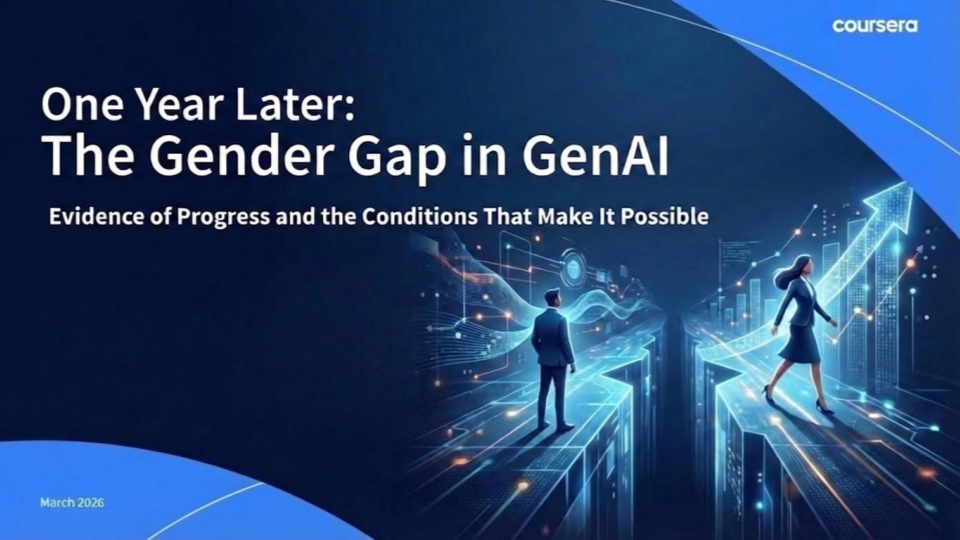
As International Women’s Day approaches, a new report from Coursera sheds light on the strides being made to close the gender gap in essential skill domains, particularly Generative AI (GenAI) and critical thinking. According to IDC research, GenAI could boost the global economy by up to $22.3 trillion by 2030. To ensure these gains are shared equitably, institutions must equip all individuals with the skills to harness these emerging technologies. The report, titled One Year Later: The Gender Gap in GenAI, analyzes enrollment data on Coursera to assess progress since the original study was released a year ago.
Global Trends in GenAI Learning #
Overall Progress Across Genders
The data reveals encouraging signs: women’s share of total GenAI course enrollments on Coursera rose from 32% in 2024 to 36% in 2025. While women remain underrepresented globally, the gap is steadily narrowing. This progress is particularly notable given the rapid growth in GenAI participation across all demographics, indicating that female engagement with the technology is accelerating faster than that of their male peers.
Enterprise Learners Show Stronger Gains
Within enterprise learning environments, the gap is closing even more sharply. Women represented 36% of GenAI enrollments in 2024 and 42% in 2025. This uptick suggests that workplace training programs are effectively reaching female employees and boosting their skills in one of the most transformative fields of the decade.
Regional Highlights and Differences #
Latin America Leads the Way
Several Latin American nations have more than doubled their share of female GenAI learners year over year. Top performers include:
- Peru (+14.5 percentage points)
- Mexico (+5.3 percentage points)
- Colombia (+4.5 percentage points)
These countries demonstrate that targeted educational initiatives can rapidly reduce gender disparities in cutting-edge skills.
Asia Pacific Nations Show Consistent Improvement
Asia Pacific countries have also narrowed the GenAI gender gap. Uzbekistan stands out globally with an 8.8 percentage point increase in female enrollments. India, the largest market for GenAI courses on Coursera, recorded a 2.2 percentage point gain. Other nations showing improvement include Vietnam, Indonesia, Thailand, and the Philippines.
Persistent Gaps in Developed English-Speaking Countries #
Declining Share of Female Enrollments
In contrast, many economically developed, English-speaking countries have seen the gender gap widen. Men’s enrollments in GenAI courses are growing faster than women’s in:
- United States (-0.9 percentage points)
- Canada (-1.0 percentage point)
- United Kingdom (-1.8 percentage points)
- Spain (-1.1 percentage points)
- Germany (-0.2 percentage points)
These declines highlight a need for targeted interventions to ensure women in these regions are not left behind as GenAI reshapes the economy.
The Path Forward #
The Coursera report underscores that while global progress is real, it is uneven. Latin America and parts of Asia offer promising models for closing the gender gap, whereas developed nations face a different set of challenges. As the world marks International Women’s Day, the message is clear: investing in women’s participation in GenAI and critical thinking skills is not just a matter of equity—it is essential for building a prosperous and inclusive future.