Quick Facts
- Category: Data Science
- Published: 2026-05-08 15:50:12
- 10 Key Insights into Using dma-bufs for Read and Write Operations
- Loopsy Launches: New Open Source Tool Enables Seamless Communication Between Terminals and AI Agents Across Machines
- The Art of the Retraction: A Step-by-Step Guide for Ethical Journalism
- Eurovision's Enduring Enigma: Why Seven Decades of Rules and Imitators Haven't Made It Predictable
- How to Balance Observability and Human Intuition When Scaling Development with AI
When working with real-time data streams or sliding windows, Python's built-in list might seem convenient, but it often leads to performance bottlenecks due to costly shift operations. Enter collections.deque — a double-ended queue designed for fast appends and pops from both ends. This Q&A explores how deque outperforms lists for sliding windows, thread-safe queues, and efficient data processing.
What is a deque and how is it different from a list?
A deque (double-ended queue) is a data structure from the collections module that allows O(1) appends and pops from either end. In contrast, a list provides O(1) appends only at the end; inserting or removing at the front requires shifting all other elements, taking O(n) time. This makes deque ideal for scenarios where you need to maintain a fixed-size window that slides over a sequence — common in time-series analysis, rolling statistics, or buffer management. Additionally, deque is implemented as a doubly-linked list of fixed-size blocks, which gives it predictable memory usage and avoids the overhead of list reallocation. While lists excel at random access, deque sacrifices that for efficient boundary operations, making it the go-to choice for continuous data streams.

Why is deque better than a list for sliding windows?
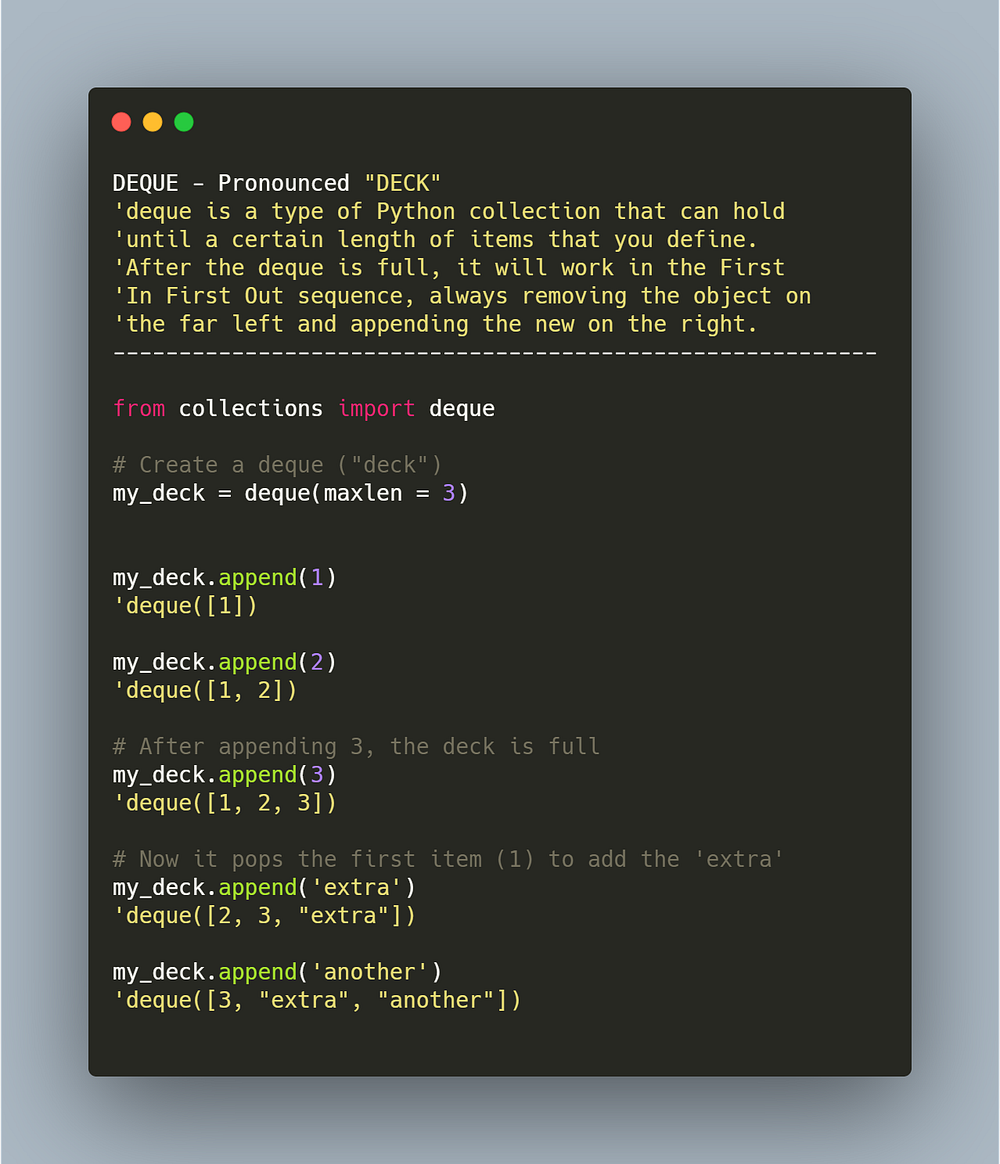
Sliding windows often require adding new elements to one end and removing old ones from the other. With a list, removing the first element (e.g., list.pop(0)) forces all remaining elements to shift left — an O(n) operation that becomes prohibitively slow for large windows or high-frequency data. A deque, on the other hand, can remove the leftmost element in constant time using deque.popleft(). Similarly, appending to the right is O(1) with deque.append(). This asymmetry in performance directly translates to faster, more predictable execution for real-time applications. Moreover, deque supports an optional maxlen parameter that automatically discards the oldest item when the window exceeds capacity, eliminating manual checks and list slicing overhead. For example, d = deque(maxlen=5) creates a sliding window of size 5 that updates automatically as you append new data.
Is deque thread-safe for concurrent data streams?
Yes, a deque is thread-safe for atomic append and pop operations at the same end, meaning multiple threads can safely add or remove items without additional locks in simple producer-consumer patterns. However, it does not provide atomic operations across both ends simultaneously — e.g., checking emptiness and then popping is not atomic. For more complex synchronization, Python's queue.Queue (which internally uses a deque) adds proper locking and blocking semantics. Nonetheless, for typical sliding window scenarios where one thread updates the window and another reads it, a deque with a lock or using the GIL's implicit serialization can suffice. The collections.deque documentation notes that its methods are thread-safe for individual operations, making it a lightweight alternative to a full queue when you only need basic bounded buffers.
How do you implement a sliding window with deque in Python?
Implementing a sliding window using deque is straightforward. First, import deque from collections and create a deque with the desired maxlen. For example, to compute the moving average of a stream of numbers: window = deque(maxlen=5). Then, for each new data point value, you call window.append(value). The deque automatically removes the oldest element if the window exceeds 5, so the sum can be updated incrementally. Code snippet: total += value - (window[0] if len(window) == 5 else 0). This yields O(1) updates per step. For more complex operations like median or max, you might maintain a second deque or use a heap. The key advantage is that deque handles boundary removal for you, eliminating manual index tracking and list copying.
What are the performance implications of using deque vs list for sliding windows?
The performance difference becomes stark as the window size grows. With a list, each removal from the front costs O(n), leading to O(n*W) total time for a stream of n elements with window size W. Deque achieves O(n) overall because each operation is O(1). In practice, for a window of size 1000, list-based sliding window operations can be 1000x slower. Benchmark tests confirm that deque is consistently faster for large windows and high-frequency data, while list may be acceptable only for very small windows (size < 10) due to Python's optimized C implementation. Additionally, deque uses less memory overhead per element compared to list's overallocation strategy. However, list has better random-access speed (O(1) vs O(n) for deque), so if you need frequent indexing into the window, deque might not be ideal. For typical sliding window computations (transforming one element at a time), deque is the clear winner.
When should you avoid using deque for sliding windows?
Despite its strengths, deque isn't always the right choice. If your sliding window operation requires frequent random access to elements in the middle (e.g., computing the median of the window via indexing), a list with manual shifting might actually be faster due to O(1) indexing, especially if the window is small. Deque's indexing is O(n) because it must iterate from one end. Also, if you need to serialize or copy the entire window often, list provides native slicing and copying that is more efficient. Additionally, for very small windows (size ≤ 5), the overhead of deque object creation might outweigh its benefits. Finally, if your use case demands advanced features like priority ordering or blocking, consider specialized structures like heapq or queue.PriorityQueue instead of deque.
What are real-world applications of deque for sliding windows?
Deque is widely used in real-time analytics, such as monitoring network traffic for anomalies, computing rolling averages of stock prices, or smoothing sensor data in IoT systems. In web scraping, deque can buffer URLs to crawl with a sliding window of recent requests. In gaming, it maintains a history of player actions for undo functionality. Python's asyncio queues are built on deque for efficient event loops. Another example is in audio processing: sliding windows over audio samples for FFT or envelope detection. The maxlen feature makes it trivial to implement a moving window of a fixed size without worrying about memory leaks. Many machine learning pipelines use deque to hold the last N training examples for mini-batch updates. In all these cases, the choice of deque over list directly translates to lower latency and higher throughput.