Quick Facts
- Category: Science & Space
- Published: 2026-05-11 11:19:21
- Massive Simulation Study Unveils Decision Framework for Choosing Ridge, Lasso, or ElasticNet Regularization
- 10 Essential Strategies to Defend Your Enterprise in an Era of AI-Powered Vulnerability Discovery
- Safari Technology Preview 242: Key Updates and Enhancements
- The Importance of Accuracy in Cybersecurity Journalism: A Case Study of the Instructure Retraction
- ClawRunr: The Open-Source Java AI Agent for Automated Task Execution – Q&A
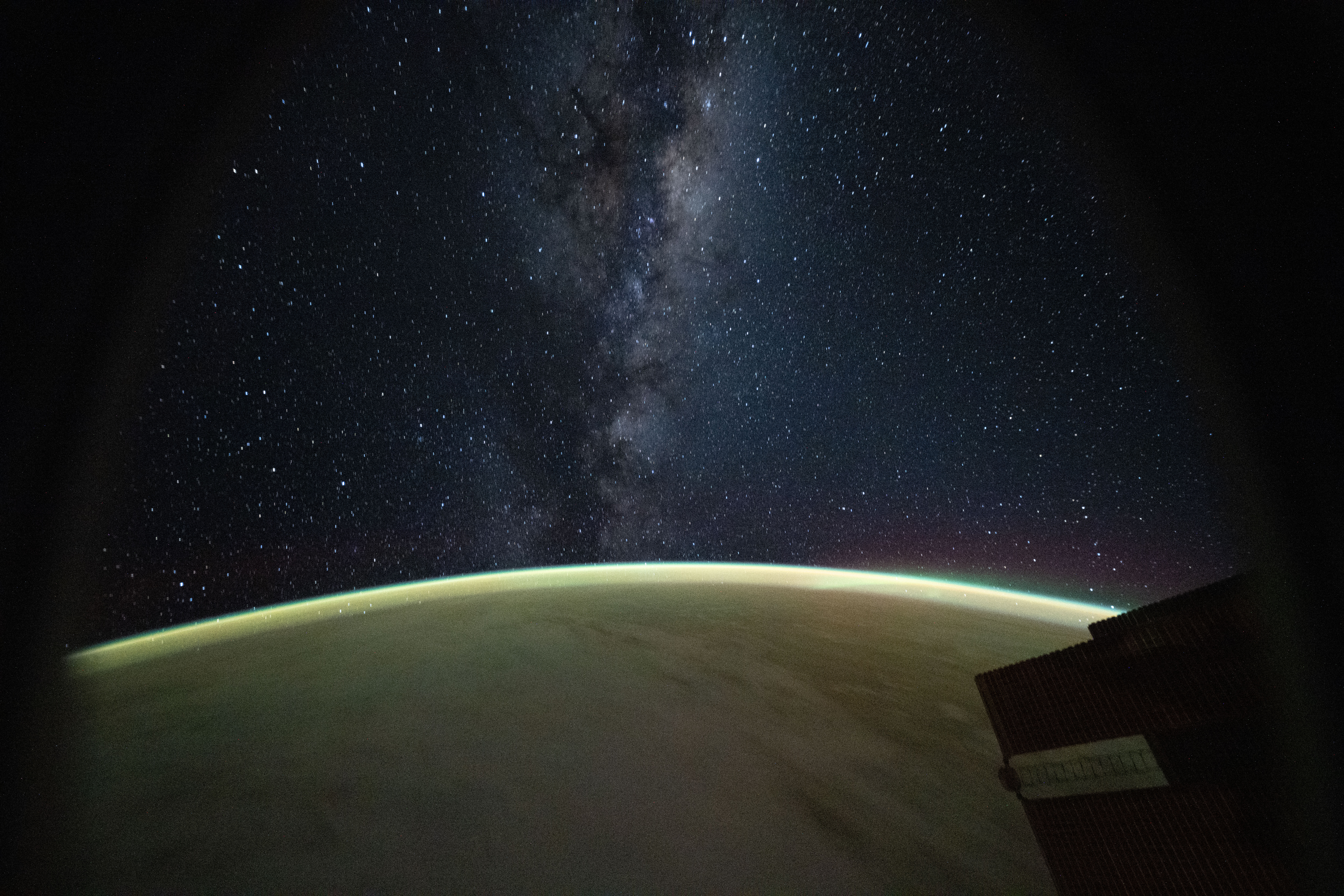
On April 13, 2026, NASA astronaut Chris Williams captured a breathtaking view of the Milky Way rising above Earth's atmospheric glow while aboard a SpaceX Dragon docked to the International Space Station. This ethereal light show, known as airglow, is a constant yet often overlooked phenomenon that paints our planet's upper atmosphere in vibrant hues. But what exactly causes this natural luminescence? And how does it differ from the familiar dancing lights of auroras? In this listicle, we explore eight key insights about airglow, drawing from Williams' stunning imagery and the science behind it. Whether you're a space enthusiast or simply curious about our planet's hidden glows, these facts will illuminate the wonders happening hundreds of kilometers above our heads.
1. The Astronaut's Unique Vantage Point
Chris Williams captured this image from a SpaceX Dragon capsule, part of a crew rotation mission to the International Space Station. The photo shows the Milky Way rising over a pale green and orange atmospheric glow, a scene only visible from low Earth orbit. Unlike ground-based observers, astronauts experience airglow as a continuous band hugging the planet's limb, providing a global perspective on this phenomenon. Williams used a high-sensitivity camera to document the subtle light, revealing details invisible to the naked eye from Earth's surface.
2. Airglow: A Constant, Natural Light Show
Airglow is the name given to Earth's faint, permanent emission of light from the upper atmosphere. It occurs at altitudes of roughly 80 to 600 kilometers, where atoms and molecules are constantly agitated by solar radiation. Unlike daylight, which is scattered sunlight, airglow is a genuine chemical glow – akin to the luminescence of a firefly or glow stick. The phenomenon is most easily observed from space or dark-sky locations on Earth, appearing as a thin, colorful layer along the horizon.
3. How Airglow Works: Sunlight's Energy Release
The process begins when atoms and molecules in the upper atmosphere absorb energy from sunlight during the day. This excited state is unstable, so the particles later release the excess energy by emitting a photon – a particle of light. Alternatively, atoms ionized by sunlight can capture a free electron, also producing a photon as they relax. The specific colors depend on the molecules involved: oxygen emits green and red, while sodium produces a yellow-orange glow. This is very similar to the physics behind neon signs, but on a planetary scale.
4. Airglow vs. Auroras: Two Different Glows
Though both airglow and auroras create atmospheric light, their origins differ sharply. Auroras are driven by high-energy particles from the solar wind that slam into Earth's magnetic field and funnel toward the poles, colliding with atmospheric gases. Airglow, in contrast, is powered by everyday solar ultraviolet radiation – no solar storms required. Airglow is also global, not limited to polar regions, and it is far fainter and more diffuse than typical auroral displays. Understanding this distinction helps scientists separate natural background emissions from space weather events.
5. The ISS: A Prime Observatory for Airglow
The International Space Station orbits at around 400 kilometers altitude, right through the region where airglow is brightest. This makes it an ideal platform for studying the mechanisms of airglow and for calibrating satellite instruments. Astronauts frequently capture images that reveal fine structures in the airglow layer, such as waves and ripples caused by gravity waves from the lower atmosphere. These observations help scientists map wind patterns and chemical composition in the upper atmosphere, which is notoriously difficult to measure from the ground.
6. Why a SpaceX Dragon Capsule Matters
Chris Williams was aboard a SpaceX Dragon during a docking procedure when he took his iconic photo. The Dragon capsule's large windows and flexible scheduling allowed him to capture the moment as the station passed into Earth's shadow. Commercial crew vehicles like Dragon have increased the frequency of such observations by enabling more crew rotations and scientific photography. The unique orientation of the capsule, with its observation dome, provided a clear, unobstructed view of the horizon.
7. Other Forms of Atmospheric Luminescence
Beyond airglow, astronauts often document related phenomena such as transient luminous events (sprites, elves, blue jets) that flash above thunderstorms, and the aurora borealis/australis. Airglow is sometimes confused with the zodiacal light (sunlight reflecting off interplanetary dust) or the gegenschein. However, airglow is unique because it originates from our own atmosphere. Studying these different glows helps researchers understand energy transfer between the sun, space, and Earth's upper layers.
8. Scientific Value: What Airglow Tells Us
Airglow is more than a pretty picture – it serves as a natural probe of upper-atmospheric chemistry and dynamics. By analyzing the colors and intensity of airglow, scientists can measure temperature, density, and the concentration of species like atomic oxygen and hydroxyl. Changes in airglow can signal disturbances from solar activity or natural oscillations like El Niño. Long-term monitoring from the ISS and dedicated satellites helps refine models of atmospheric circulation and climate. Future missions may use airglow sensors to study exoplanet atmospheres, improving our search for habitable worlds.
Conclusion
From the confines of a SpaceX Dragon module, Chris Williams' photo reminds us that even in the vacuum of space, Earth shines with its own gentle light. Airglow, a product of sunlight and atmospheric chemistry, offers scientists a window into processes occurring far above our heads. As we continue to explore low Earth orbit, astronauts will keep documenting these subtle glows, deepening our understanding of the planet we call home. The next time you see a stunning image from the ISS, remember the silent, continuous radiance of airglow – a phenomenon as constant as the stars.