Quick Facts
- Category: Technology
- Published: 2026-05-03 08:48:22
- Major Security Patch Release Across Linux Distributions: Critical Vulnerabilities Addressed
- The Edtech Vetting Revolt: 8 Key Developments in Screen Time Backlash
- Mastering Perplexity's Mac-First Personal Computer Platform: A Comprehensive Guide
- AI Assistant Defuses Linux Terminal Fear for New Users: A Case Study in Migration Ease
- Decoding the Climate Action Paradox: Why Progress Falters Despite Public Backing
Mistral AI has been quietly building one of the most practical coding agent ecosystems in the open-source AI space. With the launch of remote agents in Vibe and the public preview of Mistral Medium 3.5, the company is delivering a major infrastructure upgrade. This listicle explores the top 10 features you need to know about these new capabilities, from cloud-based coding sessions to the powerful 128B dense model that powers it all.
1. What Is Mistral Vibe and Why It Matters
Mistral Vibe is a coding agent accessible through a command-line interface (CLI). It allows an AI model to handle software tasks on your behalf—writing code, refactoring modules, generating tests, and investigating CI failures. Think of it as a tireless junior developer that operates across your codebase. Previously, Vibe sessions ran locally, tying the agent to your laptop and terminal. This limited scalability and required you to stay connected. With the new remote agents, that limitation is gone, opening up a world of asynchronous, parallel work.
2. The Major Upgrade: Remote Agents in the Cloud
The headline feature is the ability to run coding sessions remotely in the cloud. You can kick off a task from the Vibe CLI or Le Chat and let the cloud handle the rest. This means you no longer need to babysit every step—the agent works autonomously while you step away. Sessions run in isolated sandboxes, ensuring security and reproducibility. The cloud infrastructure handles long-running tasks, and you can inspect progress, file diffs, tool calls, and questions in real time.
3. How Remote Agents Change Your Workflow
Instead of being the bottleneck in a coding session, you now become an orchestrator. Start multiple agents in parallel to work on different tasks. While they run, you can review their outputs, approve changes, or provide feedback. This shift from synchronous to asynchronous collaboration dramatically increases developer productivity. The agent can even open a pull request on GitHub when finished, so you review the final result rather than every keystroke.
4. Teleporting Local Sessions to the Cloud
A particularly useful feature for developers already mid-session: ongoing local CLI sessions can be teleported up to the cloud. Session history, task state, and approvals all carry over seamlessly. You don't lose your place—just move the work off your machine. This is ideal when you need to leave your desk but want the agent to continue working. The teleportation ensures continuity and preserves context.
5. Isolated Sandbox Environments for Security
Each remote coding session runs in an isolated sandbox. This means broad edits, package installs, and other operations are contained. Mistral AI designed this to prevent unintended side effects and to protect your local environment. The sandbox also allows multiple agents to run concurrently without interfering with each other. When a task is complete, the agent can submit the work via a pull request, keeping your main codebase safe.
6. Integration with Developer Tools
Vibe plugs into a rich ecosystem of developer tools: GitHub for code and pull requests, Linear and Jira for issue tracking, Sentry for incident monitoring, and communication apps like Slack or Teams for reporting. This allows the agent to not only write code but also update issues, create tickets from errors, and notify teams of progress. The integrations make Vibe a central hub in your development workflow.
7. Mistral Medium 3.5: The 128B Dense Model Behind It All
None of this would be possible without the underlying model. Mistral Medium 3.5 is a new 128B dense model that now serves as the default in both Vibe and Le Chat. It delivers state-of-the-art performance across coding, reasoning, and general tasks. The model is designed to handle complex software engineering challenges, including refactoring, debugging, and test generation. Its architecture balances scale with efficiency, making it suitable for both cloud and local deployment.
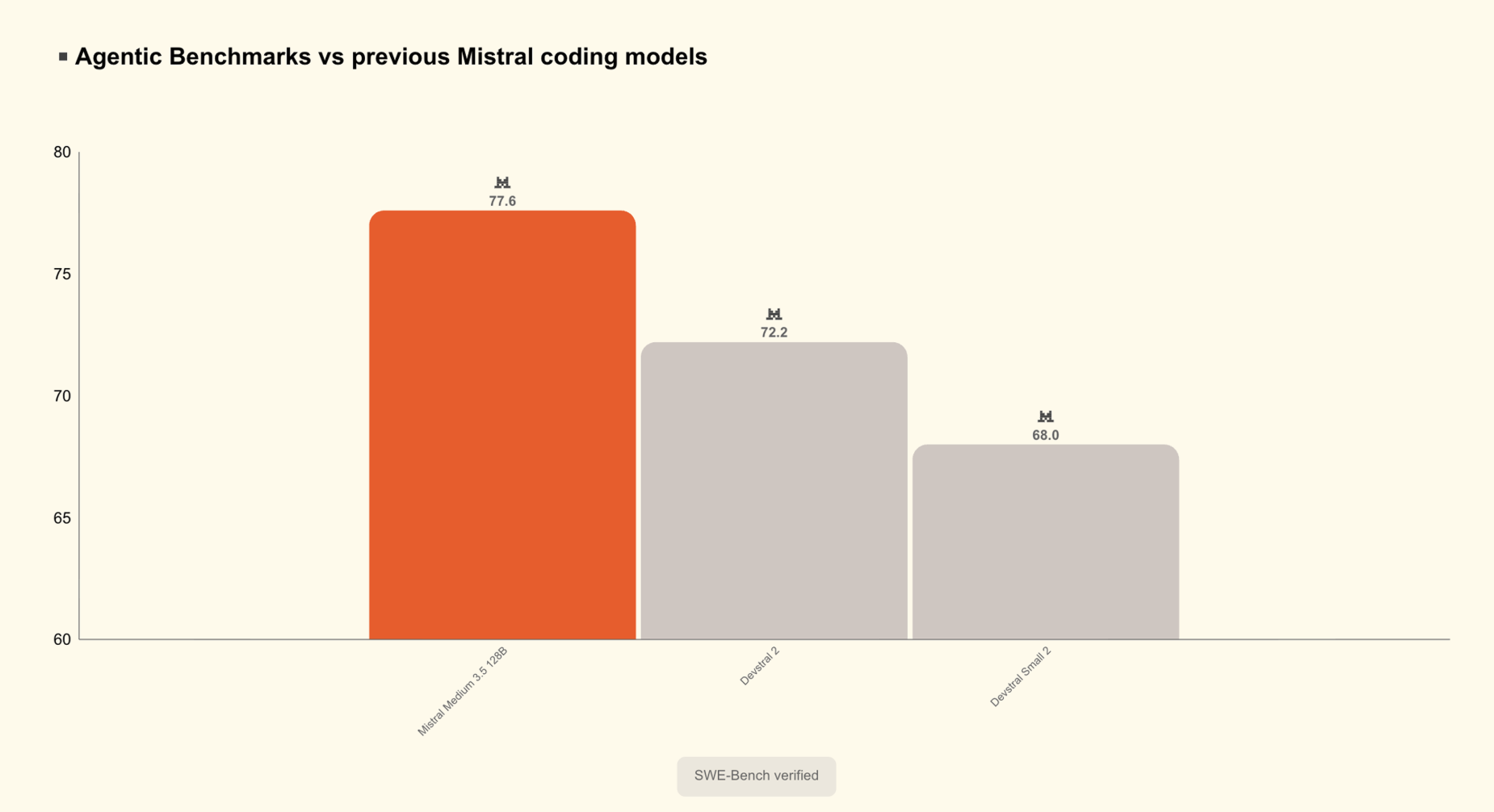
8. Benchmark Performance: 77.6% SWE-Bench Verified Score
Mistral Medium 3.5 achieved an impressive 77.6% on the SWE-Bench Verified benchmark, a rigorous test of real-world software engineering tasks. This score places it among the top-performing models for coding autonomy. The benchmark evaluates an agent's ability to resolve GitHub issues by reading code, modifying files, and running tests. This high score demonstrates Mistral Medium 3.5's capability to handle practical, open-ended coding tasks—essential for a reliable coding agent.
9. How Vibe Connects to Le Chat via Mistral Studio Workflows
Mistral uses Workflows orchestrated in Mistral Studio to bring Vibe into Le Chat. Originally built for internal use, then extended to enterprise customers, this orchestration layer is now open to everyone. The remote coding agent in Le Chat isn't a standalone feature—it's built on top of Mistral's own orchestration system. This is useful context if you're planning to architect similar agentic systems. The integration ensures consistent behavior and scalability.
10. Practical Use Cases and What's Next
Developers can use remote agents for tasks like automated refactoring of large codebases, generating unit tests, investigating failing CI pipelines, and even assisting with code reviews. The ability to run multiple agents in parallel opens up possibilities for orchestrating complex software workflows. Looking ahead, Mistral AI is likely to expand integrations, improve sandbox capabilities, and fine-tune models for even better performance. The remote agent architecture sets the stage for a new era of AI-assisted software development.
Conclusion: Mistral AI's launch of remote agents in Vibe and the Mistral Medium 3.5 model marks a significant step forward in practical coding agents. By moving sessions to the cloud, enabling parallel execution, and integrating deeply with developer tools, they have solved many of the bottlenecks that previously limited AI-assisted coding. The 77.6% SWE-Bench score proves the underlying model's capability. Whether you're a solo developer or part of a large team, these features are worth exploring to boost productivity.